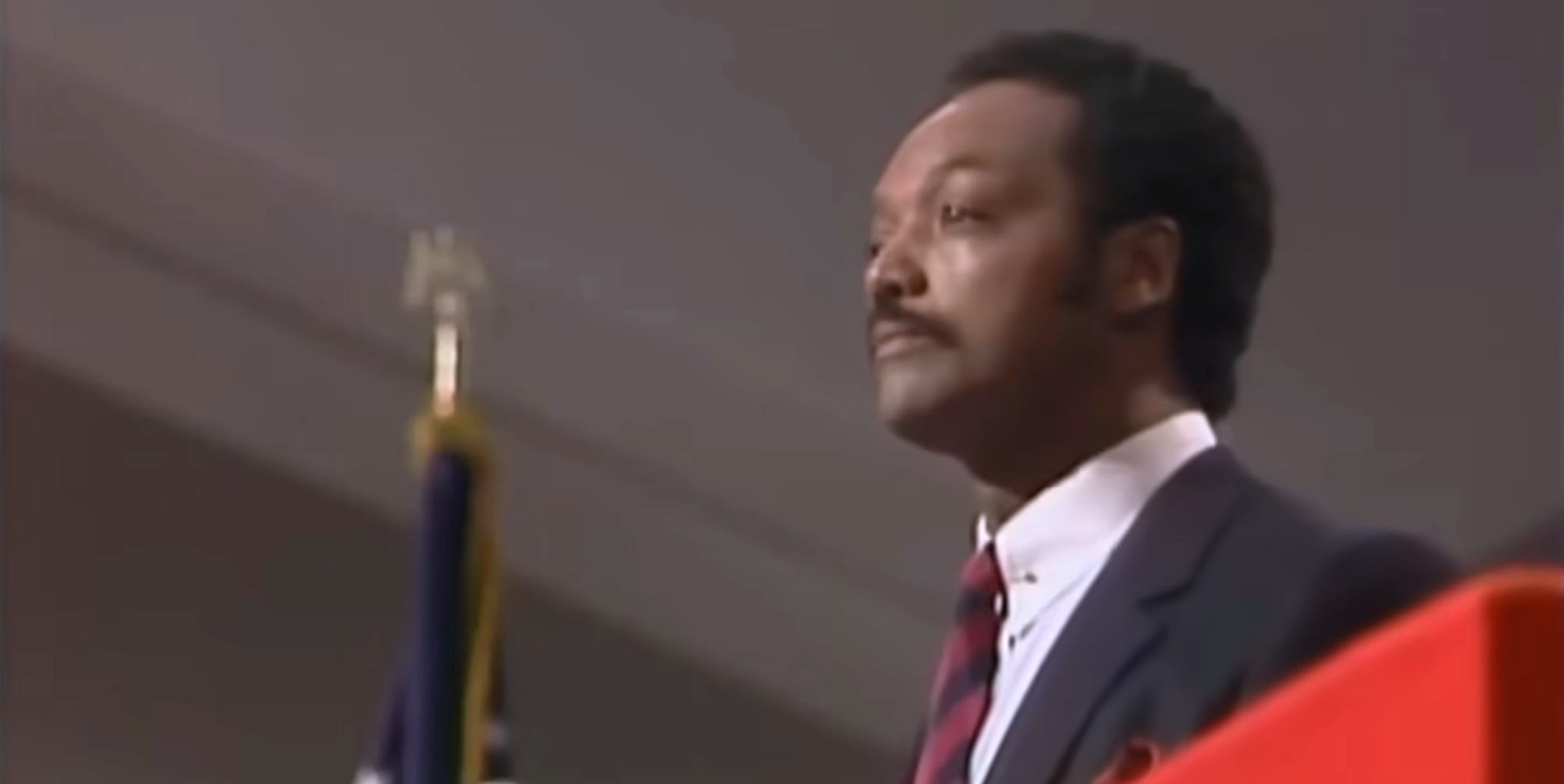
Jesse Jackson's West Village Whistle Stop
Jackson possessed an uncanny ability to transform mere opposition into optimism.
In November 1983, Rev. Jesse Jackson announced his candidacy for the U.S. Presidency. Shortly after that announcement, one day in early 1984 word spread around New York City that Jackson would be making an appearance in New York’s Greenwich Village on West 12th St. for a campaign event.
A crowd gathered in the street at the appointed time around a flatbed truck with a PA system and a few banners and campaign signs. It was a latter day facsimile of the whistle stop tour that Theodore Roosevelt had made popular many decades before — meeting the voters where they live. The location for Jackson’s appearance was only steps away from New York’s LGBT1 community center, and it was literally in the shadow of St. Vincent’s Hospital, one of the few medical facilities in New York City where people with AIDS were able to receive treatment.
With all of that as a backdrop, Jackson delivered a message of hope to a community that was facing a lot of hopelessness. Many of us were already in the throes of grief from losing friends, partners, associates, and community to this disease. We were also dealing with the additional indignity of a federal government that had refused to acknowledge publicly the existence of AIDS and had taken virtually no action to research the disease or prevent its spread. In fact, White House press briefings at the time regularly included laughter and uncomfortable homophobic taunts if a reporter even dared to bring up the subject. (I’ve included a link, but — trigger warning — the behavior of the press secretary and many in the press corps will turn your stomach.)
To say that addressing the concerns of the LGBT community at that time was unpopular is an understatement. But Jackson recognized there was a need. If anyone was familiar with speaking to disenfranchised populations, it was Jackson.
By early 1984, I had been somewhat politically active all of my adult life. I had participated in anti-war marches and rallies. I had organized local activities for the original Earth Day and attended environmental rallies. After I came out in 1973, the logical next step for me was to become politically active, participating in a gay liberation organization and marching in early gay rights marches (the precursors to today’s Pride parades). My activism impulse got focused almost exclusively in the direction of LGBT rights.
Despite being a serial protester, I had somehow never been exposed to quite such a message of hope as Jesse Jackson delivered that night. My perception of activism at the time was that it seemed to focus more on what we were against rather than what we were for. But Jackson introduced me to political activism from an entirely different perspective.
It’s not that I hadn’t felt surges of enthusiasm from previous events — protesting Nixon outside his hotel, hearing Pete Seeger sing at a Vietnam war protest for the first time, my first gay rights march. But those events were centered around opposition to the status quo and not necessarily focused on a vision for the future. Jackson’s speech was different, but what was made it different wasn’t apparent to me at the time. I understand it far better in retrospect than I did in the moment.
There were some at the time who were somewhat cynical about his appearance in what, at the time, was the gay neighborhood of New York City. Was he here merely to harvest votes from a segment of the population whose votes were valuable but whose lives were, shall we say, less than valued? That was a phenomenon that New Yorkers in that neighborhood and others were familiar with, and suspicion may have been at its peak in that era — and with good reason.
I think for most who were in attendance, if that cynicism were present at the outset, it had been largely dispelled by the end of the event. The reason? Hope.
I can’t quote any specific thing that Jackson said that night; it was, after all, more than forty years ago. But I can still remember the feeling that coursed through the crowd. It was hope. It was the excitement that there might just be some in the political realm who were possibly advocating for us.
It had been nearly six years since Harvey Milk, the LGBT community’s most notable purveyor of hope had been assassinated. We were now living in a time that our federal government — along with many of our religious institutions, our employers, and even our families — had completely kicked us to the curb.
So when Jesse Jackson awakened some sense of hope in many of us with that speech, it wasn’t just about that evening or that speech or even about his candidacy. In fact, few believed that he stood much of a chance of prevailing in the primary, no less in the general election. Rather, it was about the possibility that there might be a fork in the road of history that could lead all disenfranchised communities to a greater measure of equality, respect, and unity.
Jackson’s trademark chant — “Keep Hope Alive!” — did exactly what it was intended to do, on that night and likely thousands of other days and nights like it. Jackson’s candidacy and his unwavering belief in what was possible helped form the current day progressive movement. It paved the way, decades later, for a Black President of the United States — a President whose message also was centered around hope and around what was possible.
We’re currently undergoing some unfathomably dark and challenging times. But Jesse Jackson’s entreaty to keep hope alive is as important now as it ever has been. His passing is a reminder to keep our focus on what is possible, not on what is dragging us down.
R.I.P. Jesse Louis Jackson
Please note that I have written this from memory. I’ve tried to track down specifics of this event, and they’re scarce. Consequently, dates and details may be a bit fuzzy. Please feel free to help me fill in the blanks in the comments.
In this post, I use LGBT to describe the community, rather than the more current LGBTQ descriptor, because that’s what was in use at the time of these events.


Thanks for this. I attended this Jesse Jackson's speech on 13th Street. We all stook in the middle of the street and listened. I cannot recall ever being so moved by a political speech. By the end of it, many of the people attending, myself included, were brought to tears by Mr. Jackson's eloquence.
What a beautiful memorial post. One part of your writing brought me to tears…
“Rather, it was about the possibility that there might be a fork in the road of history that could lead all disenfranchised communities to a greater measure of equality, respect, and unity.”
I live in SW Mississippi, & “The Forks of the Road” is special to me. I used to load my electric mower into the back of my car & mow the property as a sign of communion & respect to those slaves who died there, black & white (“Wash”- few folks understand “Wash”). There is a memorial. Broken shackles.
Someone would often leave flowers there that I would tidy & was careful not to disturb. Once a newspaper employee even stalked & harassed me there…but when I referred them to Mr. Boxley, (a real & black local historian) they sure didn’t want to speak to him.
Forks of the Road was once one of the largest slave markets in the confederate South.
Nowadays NPS cares for the Forks of the Road property, but tourists get to learn some real history - not just the antebellum homes bullsh*t.
The slaves shackles are a burden no longer. That is the only way I can describe to you what I feel when I visit or think about the Forks of the Road.
The shackles are broken.